Spironolactone vs Accutane: Which Fits Your Hormonal Acne?
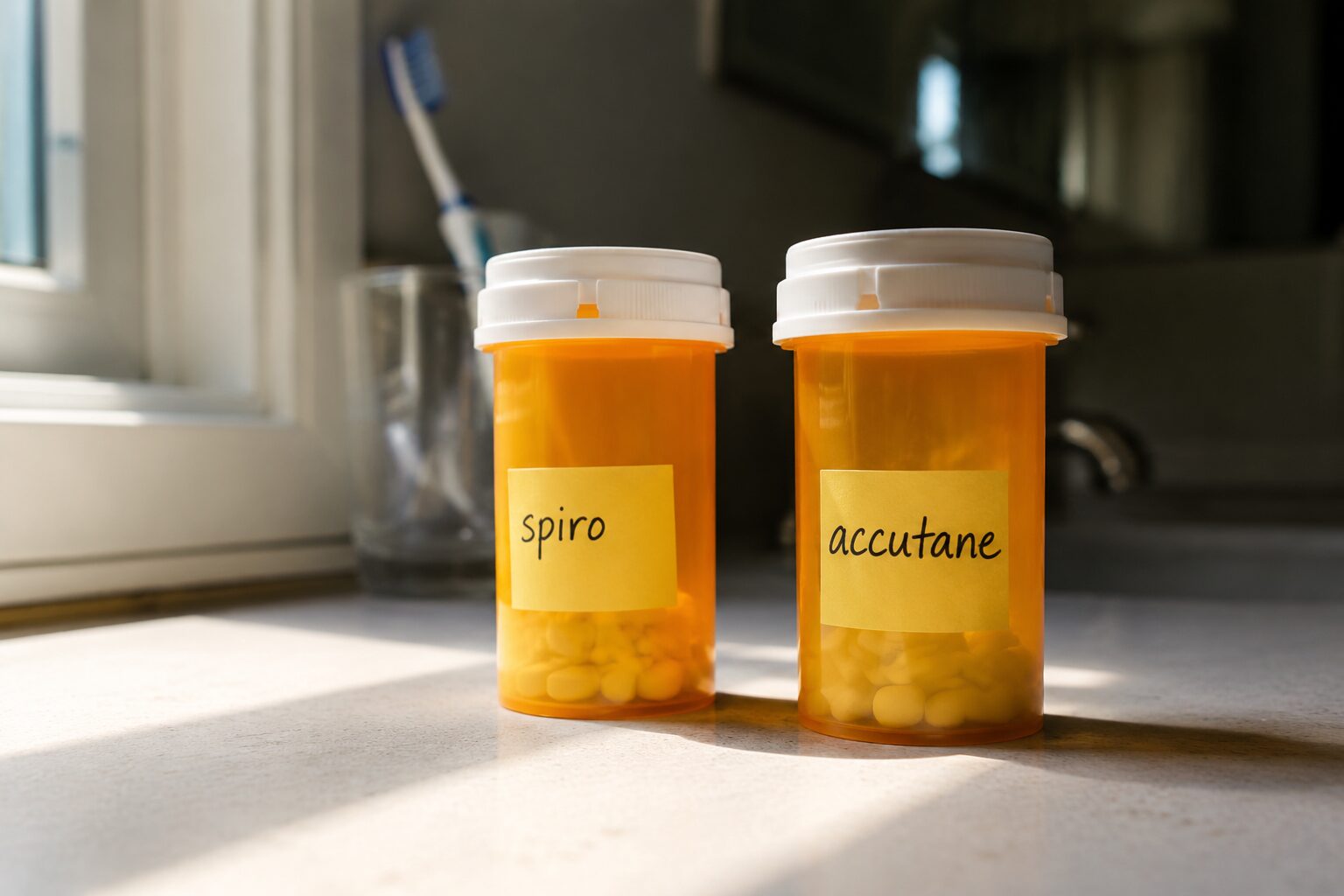
Quick answer: Spironolactone and Accutane® (isotretinoin) are different kinds of drugs, and neither one is a form of the other. Spironolactone is a blood pressure and fluid pill that dermatologists also prescribe as hormonal therapy for acne in women. A patient it helps may stay on it for a long time. Accutane® is a retinoid taken under the iPledge program for a set course, often 15 to 20 weeks, that dermatologists tailor to each patient. The 2024 AAD acne guideline strongly recommends it for acne that is severe, causing psychosocial burden or scarring, or failing standard oral or topical therapy. A board-certified dermatologist decides which one fits your acne, and a prescription is never guaranteed.
This comparison is for women with breakouts along the jawline, lower face and neck who want to know what each drug demands.
If you’re a man reading this, the American Academy of Dermatology states that spironolactone isn’t prescribed to treat acne in men because of side effects. It notes that men have developed breasts while taking it for acne. Men weighing prescription options should start with our page on acne treatment for men and the article on side effects of Accutane® for men.
Is spironolactone a form of Accutane®?
No, spironolactone isn’t a form of Accutane®, and the two drugs belong to different classes. MedlinePlus describes spironolactone as an aldosterone receptor antagonist used for high blood pressure, heart failure, fluid retention and a few related conditions. Acne isn’t on that list of uses. The American Academy of Dermatology explains that dermatologists have prescribed it for many years to treat acne and excess hair growth in women.
Isotretinoin belongs to a different class, the retinoids. MedlinePlus says isotretinoin works by slowing the production of certain natural substances that can cause acne. The FDA label for Accutane® lists one use, severe recalcitrant nodular acne. It says the drug should be reserved for severe nodular acne that hasn’t responded to conventional therapy, including systemic antibiotics.
Spironolactone has no FDA approval for acne, since the Aldactone® label lists heart failure, high blood pressure, edema and hyperaldosteronism. The American Academy of Dermatology’s 2024 acne guideline gives spironolactone a conditional recommendation, the same grade it gives combined oral contraceptive pills. The same guideline strongly recommends oral isotretinoin for acne that’s severe, causes psychosocial burden or scarring, or fails standard oral or topical therapy.
Which kind of acne does each drug treat?
The AAD says women with acne along the jawline and lower face tend to have good results from hormonal therapy. It adds that spironolactone can treat deep-seated, tender acne on the lower face, jawline or neck when other treatments don’t work. The guideline’s isotretinoin criteria are different: acne that’s severe, scarring, causing psychosocial burden, or failing standard oral or topical therapy.
A hormonal pattern doesn’t rule out Accutane®, though. The Goal Is Clear’s Accutane® FAQ says “hormonal acne that keeps returning after topicals or antibiotics can qualify, in men and women”. What decides it is severity, scarring, psychosocial burden or failing standard oral or topical therapy, using the guideline’s criteria above.
The AAD notes that if you’re 35 or older, the birth control pill may not be an option, and spironolactone alone may be prescribed. It also says spironolactone without the pill is recommended when a condition such as a past blood clot or stroke makes the pill unsafe. More is in our spironolactone for acne article.
How well does each drug work?
A recent spironolactone study is the SAFA trial, published in the BMJ in 2023. It randomly assigned 410 adult women with facial acne, judged to need oral antibiotics, to spironolactone or a placebo.
At week 24 of the SAFA trial, 82% of the spironolactone group reported improvement, against 63% of the placebo group. At week 12 the difference wasn’t significant, at 72% against 68%. The authors concluded that spironolactone is a useful alternative to oral antibiotics for women with acne. The AAD’s public page also describes a review of 85 women’s medical records, where a third had complete clearing, a third had noticeably less acne, and only 7% saw no improvement.
For isotretinoin, the FDA label says a single course of 15 to 20 weeks has been shown to produce complete and prolonged remission in many patients. The AAD adds that the clearance can be permanent for some patients. If a second course is needed, the label says it shouldn’t start until at least 8 weeks after the first one ends, because patients may keep improving off the drug.
How long do you take spironolactone compared with Accutane®?
Spironolactone is an ongoing medicine, while the AAD describes isotretinoin as a course of about four to five months. The AAD says that when hormonal therapy helps clear acne, a patient may stay on it for a long time, and that long-term use appears to be safe. It also says hormonal therapy can be used alone to prevent new breakouts, and other treatments such as an antibiotic are often stopped.
The AAD says women can see fewer breakouts and less oiliness within a few weeks. The SAFA trial found a clearer gap over placebo at 24 weeks than at 12. The full timeline is in our article on how long spironolactone takes to work for acne, and dose questions are covered in spironolactone dosage for acne.
What does each drug ask of you month to month?
Spironolactone asks for blood tests before you start and visits every 4 to 6 weeks while the dose is raised. Isotretinoin adds the iPledge program, which under today’s rules sets a pickup deadline for every prescription.
Spironolactone: blood tests and dose steps
The AAD says you’ll need some blood tests before spironolactone is prescribed. It also says the dose is raised gradually, so you’ll have a follow-up visit every 4 to 6 weeks when you start. Ongoing potassium checks are a separate question.
A 2015 study in JAMA Dermatology looked at 974 healthy young women taking spironolactone for acne. Of their 1,802 potassium tests, 13 were high, a rate of 0.72% that matched the 0.76% baseline rate in similar women. The authors concluded that routine potassium monitoring is unnecessary for healthy women taking it for acne.
That study only looked at healthy women. The Aldactone® label says the risk of high potassium rises with kidney problems and with potassium supplements or potassium-containing salt substitutes. Blood pressure drugs called ACE inhibitors and ARBs raise it too. The Goal Is Clear’s eligibility page says lab work for potassium “may be needed depending on dose and risk factors”. Spironolactone has no enrollment program, and the Aldactone® label sets no pickup window.
Accutane®: iPledge, windows and tests
Every isotretinoin patient in the United States must be registered with iPledge, MedlinePlus explains, including men and women who can’t become pregnant. For patients who can become pregnant, the FDA label says the prescription must be obtained within 7 days of the pregnancy test’s specimen collection date. Patients who can get pregnant must use two separate forms of effective birth control at the same time, the label says. That runs from one month before treatment until one month after the last dose. For patients who can’t become pregnant, the label’s window is 30 days from the office visit.
The FDA requires pre-treatment pregnancy tests to be done in a medical setting, so for an online patient who can get pregnant, those tests happen at a lab. During and after treatment, the FDA allows home tests if the prescriber permits them. The Accutane® label also calls for blood lipid tests before treatment and at intervals until the lipid response is established, usually within 4 weeks. It calls for pretreatment and follow-up liver function tests at weekly or biweekly intervals until the response is established. It bars donating blood during treatment and for one month after it ends.
Changes to iPledge are approved, but as of October 6, 2026, they aren’t in effect. The FDA approved the modifications on February 9, 2026, and later moved the start date to November 15, 2026. That change also will end the 30-day window for patients who can’t become pregnant. Until the November 15, 2026 changes take effect, the current rules apply, and your prescriber and pharmacy can tell you what changes for your own case.
Two process details from our iPledge concierge work matter here. We’ve never seen the program send anyone a countdown as a pickup window nears its end, so someone has to track the dates. The lab order is also its own document, separate from the visit note, and people regularly reach the draw site with the wrong paper.
How do the side effects compare?
Spironolactone’s common side effects involve periods and breasts, while the Accutane® label lists dryness as the common, less serious one, alongside serious warnings. The AAD lists painful periods and cramping, irregular periods, breast tenderness and breast enlargement as the most common spironolactone side effects when it’s taken without the pill. It says these may lessen when women also take the pill.
The AAD adds that fatigue, headache and dizziness are possible, and that spironolactone is a diuretic, so you’ll urinate more often. In the SAFA trial, headaches were reported by 20% of the spironolactone group and 12% of the placebo group, with no serious adverse reactions reported. MedlinePlus warns that drinking alcohol on spironolactone may cause dizziness, lightheadedness and fainting when you get up too quickly from a lying position. The AAD says to skip coconut water and supplements that contain potassium.
The Accutane® label names dry skin, chapped lips, dry eyes and a dry nose that may lead to nosebleeds as its common, less serious side effects. The same label warns that the drug may cause depression, psychosis and, rarely, suicidal thoughts and behaviors or aggressive behavior. It tells prescribers to ask patients and family members about psychiatric history before treatment. At each visit they check for depression, mood changes, psychosis or aggression.
Our pages on spironolactone side effects and the complete guide to Accutane® cover the full lists.
What if you’re planning a pregnancy?
Both drugs carry pregnancy warnings, and the AAD and the Accutane® label both call for birth control if you can become pregnant. The AAD says it’s essential to use birth control while taking spironolactone, because a pregnancy on the drug can lead to serious birth defects. The Aldactone® label says to avoid it in pregnant women, or advise them of the potential risk to a male fetus, because of its anti-androgen properties.
The AAD also notes that taking spironolactone with the pill can increase its effectiveness. The Goal Is Clear’s FAQ says spironolactone often pairs with topicals or birth control depending on the case. Our article on spironolactone and birth control for acne explains that pairing.
Isotretinoin’s pregnancy rules are stricter still. The FDA label warns of an extremely high risk of life-threatening birth defects if pregnancy occurs while taking it in any amount, even for short periods. MedlinePlus lists a pregnancy test when you take your last dose and another 30 days later. Because both drugs carry birth control rules, pregnancy plans belong in the first conversation with your board-certified dermatologist.
Can you switch from spironolactone to Accutane®?
If your acne meets the isotretinoin criteria above, your board-certified dermatologist can weigh a switch. The 2024 guideline’s criteria include acne that’s severe, scarring, causing psychosocial burden, or failing standard oral or topical therapy. Whether a spironolactone trial counts toward that, and when to stop it, is also your board-certified dermatologist’s call.
Before a switch, if you can become pregnant, MedlinePlus says you need two negative pregnancy tests first, and the FDA requires them in a medical setting. The iPledge FAQ walks through the timing of those first tests.
How does The Goal Is Clear offer each drug?
The Goal Is Clear offers both drugs through board-certified dermatologists, and its track for hormonal acne in women is GurlRX. The company describes GurlRX as a track “designed around hormonal history, cycle, and related pathways,” including spironolactone “when clinically appropriate for patients who can use it”. Its FAQ says spironolactone is part of the treatment library for hormonal acne “in adult patients who can use it”.
A board-certified dermatologist licensed in your state reviews each case, and the company doesn’t use nurse practitioners or physician assistants to diagnose acne or write prescriptions. For spironolactone, the FAQ says the board-certified dermatologist weighs your history, other medications and lab needs during intake. If isotretinoin is prescribed instead, the iPledge Concierge tracks your monthly windows, pregnancy tests and refills, with an alert when a window opens and before it closes.
The Concierge also tracks both iPledge rule sets and switches automatically on the implementation date, now set for November 15, 2026. Care is one flat price, the pharmacy bills medication separately, and some insured patients pay as low as $0 for the prescription. Plan prices are on the pricing page. You pay at checkout and get a full refund if your board-certified dermatologist doesn’t prescribe. BNG Health Services, LLC operates the brand and is not the prescribing physician.
Common questions about spironolactone vs Accutane®
Is spironolactone the same as Accutane®? No, they’re different drugs that treat acne in different ways. MedlinePlus classes spironolactone as an aldosterone receptor antagonist, and the AAD says dermatologists prescribe it for acne in women. Accutane® is a brand of isotretinoin, which the FDA label approves for severe recalcitrant nodular acne. MedlinePlus calls it a retinoid and says every patient must be registered with iPledge.
Is spironolactone or Accutane® better for hormonal acne? Neither one is better for every woman, because they answer different problems. The 2024 AAD guideline strongly recommends isotretinoin for acne that is severe, causing psychosocial burden or scarring, or failing standard oral or topical therapy. It gives spironolactone a conditional recommendation.
Can men take spironolactone for acne? No, the American Academy of Dermatology says spironolactone isn’t prescribed to treat acne in men because of side effects. Men have developed breasts while taking it for acne. Men with stubborn acne can read about acne treatment for men, where isotretinoin is one of the options a board-certified dermatologist may consider.
Do you need blood tests on spironolactone? The AAD says you’ll need some blood tests before it’s prescribed. A 2015 JAMA Dermatology study found routine potassium monitoring unnecessary for healthy women taking it for acne. The Aldactone® label says kidney problems and certain medicines raise the risk, so your board-certified dermatologist decides.
Does spironolactone need iPledge like Accutane® does? No, the FDA describes iPledge as a program for isotretinoin products, and the spironolactone label sets no enrollment program or pickup window. You still need birth control on spironolactone if you can become pregnant, because the AAD warns a pregnancy on it can lead to serious birth defects.
Which drug should you raise with your board-certified dermatologist?
Ask about spironolactone if your breakouts sit on the jawline, lower face or neck and you’d rather take an ongoing pill without an enrollment program. Ask about isotretinoin if your acne is severe, scarring, weighing on you, or failing standard oral or topical therapy.
To have a board-certified dermatologist look at your case, take the two-minute quiz and upload a front photo and a side photo. A board-certified dermatologist reviews your case within 24 hours, and the about page explains who runs the company.
This article is general information, not medical advice. A prescription is never guaranteed, and treatment decisions stay with the board-certified dermatologist who reviews your case. Accutane® is a registered trademark of its respective owner, and isotretinoin is the generic name. Aldactone® is a registered trademark of its respective owner. The Goal Is Clear is operated by BNG Health Services, LLC, which is not the prescribing physician; independent board-certified dermatologists prescribe.
Sources
- Reynolds et al., Guidelines of care for the management of acne vulgaris, J Am Acad Dermatol 2024
- Santer et al., Effectiveness of spironolactone for women with acne vulgaris (SAFA), BMJ 2023
- Plovanich et al., Low usefulness of potassium monitoring among healthy young women taking spironolactone for acne, JAMA Dermatol 2015
- American Academy of Dermatology, Stubborn acne? Hormonal therapy may help
- American Academy of Dermatology, Isotretinoin: Overview
- Accutane (isotretinoin) prescribing information, DailyMed
- Aldactone (spironolactone) prescribing information, DailyMed
- FDA, iPLEDGE Risk Evaluation and Mitigation Strategy (REMS)
- MedlinePlus, Spironolactone
- MedlinePlus, Isotretinoin
General information from published sources, not medical advice. Your dermatologist makes every treatment decision after reviewing your case. The Goal Is Clear is operated by BNG Health Services, LLC, which is not the prescribing physician.
← Blog Home